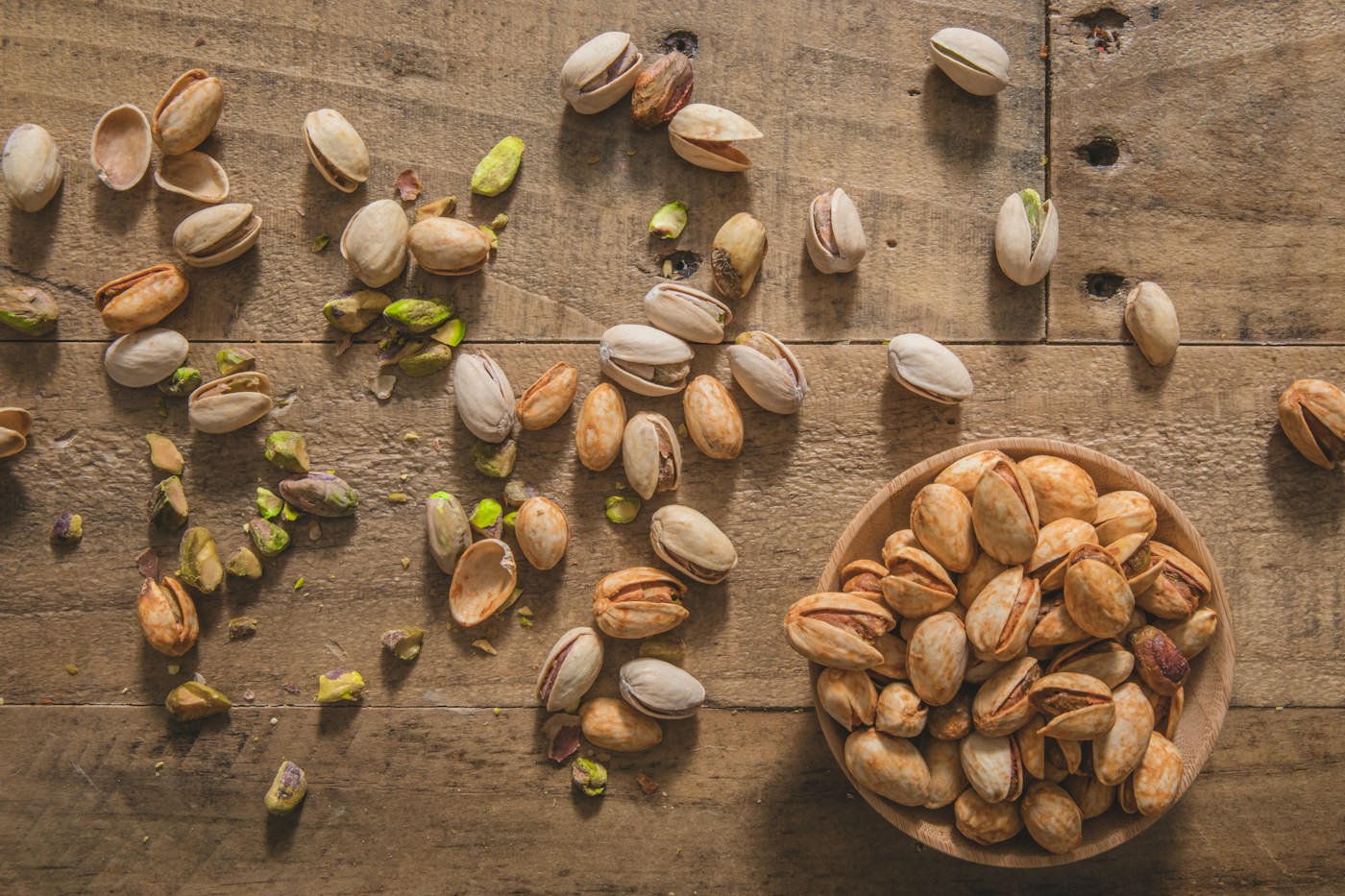
Pistachios do not automatically cause weight gain. Like other foods, they provide energy, and the amount you eat matters. The clinical trials reviewed did not find a significant increase in body weight when pistachios were included in the diets studied. This does not mean you can eat unlimited amounts or that pistachios are a weight-loss product.
Two questions help put the concern in context: how much do you eat, and how do pistachios fit into your overall diet?
Why calories do not tell the whole story
Pistachios contain fat, protein and fibre. They provide substantial energy in a small volume, so a large bag can contain several portions. But looking only at the calories in 100 g cannot predict a person's weight: the rest of their food intake, activity and individual needs also matter.
Eating pistachios instead of another snack changes the overall diet. Adding them to everything you already eat, without making other adjustments, can increase your total energy intake. Providing calories does not mean a food necessarily causes weight gain.
What research says about pistachios and body weight
A 2020 systematic review combined 11 trials involving 1,593 participants. Compared with control diets, diets containing pistachios did not produce statistically significant differences in body weight or waist circumference. The review found a small reduction in body mass index, but this does not justify promising a weight-loss effect. Read the review.
Another 2020 trial followed 100 adults with overweight or obesity for four months. Both groups took part in a weight-loss programme; one group also ate 42 g of pistachios daily. Weight loss was similar in both groups. This shows that pistachios could fit into that programme, not that they caused the weight loss. Read the trial.
These studies have limits: they examine particular amounts, time periods and populations. The second trial was funded by American Pistachio Growers, and its authors declared no conflicts of interest. This context helps interpret the evidence but does not replace individual advice.
How much is a portion of pistachios?
To visualise an amount, weigh 30 g of the edible kernels and serve them in a bowl. This is a practical example, not a required amount for everyone. Remove hard shells before weighing: 30 g of in-shell pistachios is not the same as 30 g of kernels.
To calculate the energy in those 30 g, multiply the package's kcal per 100 g by 0.30. Avoid assigning the same number to every product: preparation and ingredients can change it. There is no need to count a fixed number of nuts, as their size varies.
- Serve what you intend to eat and put the bag away.
- Consider whether you are replacing another snack or adding an extra one.
- Account for the whole dish when adding pistachios to pesto, dessert or salad.
Are raw pistachios less fattening than roasted ones?
Roasting changes flavour and texture. The words “raw” and “roasted” alone do not tell you which product provides less energy: compare the labels and ingredients. Pistachios roasted without added oil are different from preparations containing oil, sugar or other ingredients.
Salt does not provide calories, but choosing a product without added salt helps you control salt in your overall diet. It does not make pistachios calorie-free. Green Beat's roasted in-shell pistachios have no added salt; you can also choose raw pistachios. Explore our guide to raw and roasted pistachios.
What about eating them at night or as a spread?
There is no reason to attribute a special weight-gain effect to pistachios simply because you eat them at night. Timing alone cannot predict the outcome: consider your habits, the amount and your overall diet.
Pure pistachio paste still provides the energy of the nuts. A commercial spread may contain sugar, oils or other ingredients, so check its composition. Our homemade pistachio spread recipe uses kernels alone, but “no added sugar” does not mean “no calories”.
Choose pistachios to enjoy them
If you like pistachios, think of them as food that can fit into different meals, rather than automatically labelling them as either fattening or slimming. Choose an amount that makes sense for you and enjoy the flavour. For cooking, shelled pistachio kernels save preparation time.
If you need to adjust your diet for a health condition or weight goal, a registered dietitian can help personalise it. Pistachios are a tree nut and an allergen: they are unsuitable for someone allergic to them.
Sources and editorial approach
Prepared by the Green Beat team on 10 November 2026 using the studies linked below. This is general information, not an individual clinical assessment. We do not attribute weight-loss properties to our products.
- Xia and colleagues (2020). The relationship between pistachio (Pistacia vera L) intake and adiposity: A systematic review and meta-analysis of randomized controlled trials. Medicine. Full text.
- Rock and colleagues (2020). Effects of Pistachio Consumption in a Behavioral Weight Loss Intervention on Weight Change, Cardiometabolic Factors, and Dietary Intake. Nutrients. Full text.
Pistachio nutrition
Explore pistachio nutrition and practical ways to enjoy them.