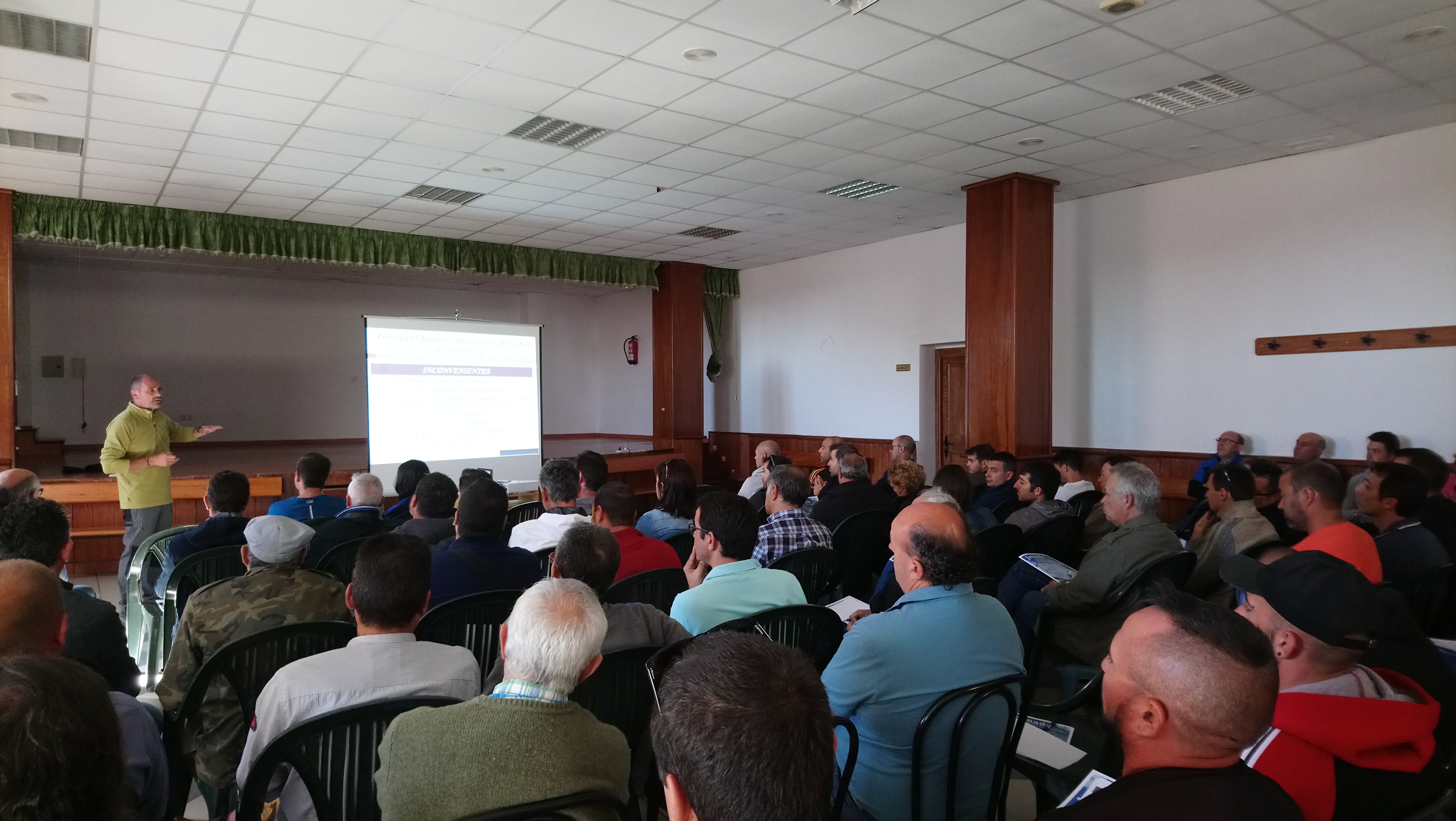
On Saturday 15 June, we organised the province’s first workshop on organic pistachio growing in Bóveda de Toro, Zamora. The event formed part of the Castilla y León regional government’s programme supporting the development and promotion of organic agriculture. At Ysolkrea S.L., we believe in innovation as a way to improve the growing, processing and marketing of pistachio products under the Pistachos Green Beat brand. We follow circular economy principles at every stage and use certified, entirely organic methods.
More than 50 people attended. Most were farmers from Zamora, with others travelling from Palencia, Valladolid, Salamanca and León. They shared one aim: to learn more about pistachio growing and organic production.
Julián Guerrero Villaseñor, a graduate in Biological Sciences with a doctorate in Agronomy, led the theory and practical sessions. He has contributed to numerous pistachio projects, conferences, articles and publications, and advises on the experimental field. His session, “Agronomic aspects of the pistachio tree: plant material and growing techniques”, introduced the global pistachio market, producing countries and key opportunities.
The figures presented at the workshop showed a growing domestic market. Castilla y León had 298 hectares of rain-fed pistachio orchards and 954 irrigated hectares, with just 125 rain-fed and 148 irrigated hectares already producing. These figures were well below those for Castilla-La Mancha, which had 16,904 rain-fed and 5,211 irrigated hectares planted, including 5,761 rain-fed and 1,598 irrigated hectares in production. We also examined a map of suitable growing areas in our region, using information supplied by Itacyl.
The pistachio tree is a long-lived, deciduous, dioecious fruit tree in the Anacardiaceae family, alongside cashew, mango, mastic and sumac. It grows naturally in semi-desert climates in Central Asia, the Middle East and the Mediterranean. In cultivation, the tree combines a rootstock below ground with a variety above ground.
The main conditions for growing pistachios and obtaining high-quality fruit are:
- No spring frosts, or a low likelihood of frost, in April and May.
- Low atmospheric humidity during the growing period.
- Little prolonged rainfall during flowering.
- Sufficient heat for ripening.
All these conditions can be found at Green Beat’s Finca Doña Amor in Zamora.
The participants had different levels of experience. Some were still deciding whether to plant pistachios, others had recently begun growing them, and some were already experienced producers. Everyone had the opportunity to explore trees and varieties, grafting, suitable growing areas, soil requirements, main pests, production methods and much more. We reviewed production costs and average profitability in rain-fed and irrigated orchards, alongside Julián’s advice on avoiding surprises in a crop that demands considerable technical knowledge.
At the end of the agronomy session, we examined data from experimental work at the Green Beat farms. These trials aim to improve understanding of organic pistachio growing in our region through learning and continuous improvement. Comparative information about conventional and organic production, together with available organic farming support, can help more growers consider sustainable, organic methods.
Marian Crespo, event organiser and Ysolkrea’s manager, explained: “It has been a year since we started the experimental field. Although it is still early, we have already obtained our first results. Practices including temporary legume cover crops, organic sheep manure and other organic fertilisers have increased organic matter and reduced pH.”
Out in the orchard, Julián Guerrero demonstrated summer pruning techniques and gave advice on graft management and key growing tasks. Participants could ask questions and resolve doubts directly. At Green Beat’s organic pistachio facilities, we also saw the solar and fertigation infrastructure developed by i-solagua. This was part of an innovation programme to improve efficiency through sensors, artificial intelligence using machine learning, and computerised remote management.
The day ended with farmers exchanging experiences and tasting local organic products. Together, they helped build a community of knowledge with the aim of placing Castilla y León at the forefront of exceptional-quality organic pistachio production.